

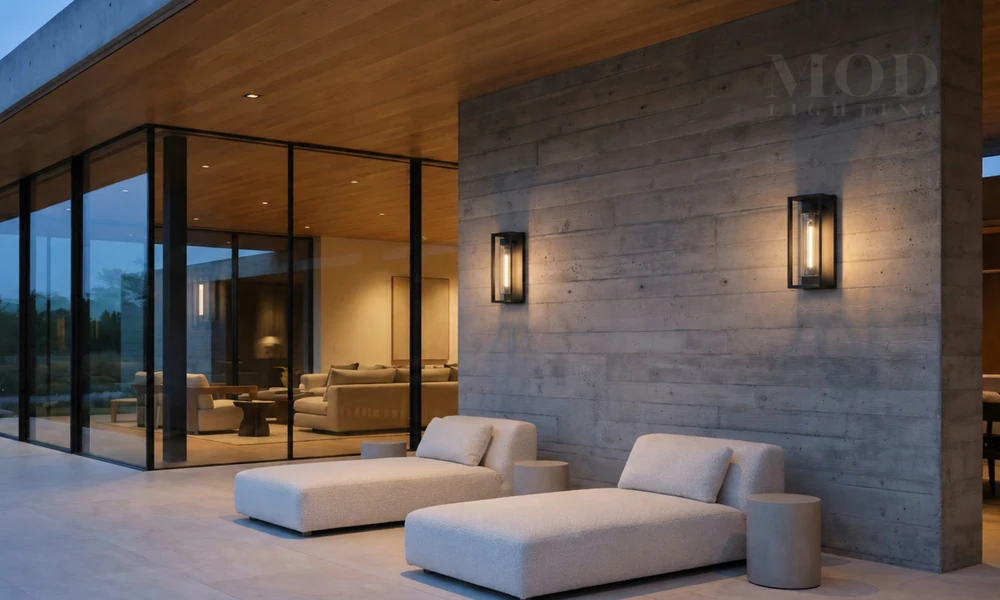
Wall lights by the front door, garage, or patio do a lot of work. They help you find your keys, make steps safer, and set the tone for the house. They can also annoy your neighbors, blind visitors, and waste energy if they are chosen poorly. A little planning gets you the welcome you want without the glare.
What good outdoor lighting does
The Pennsylvania Outdoor Lighting Council describes good outdoor lighting as providing the right amount of light, not too little and not too much, while minimizing glare, light trespass, and energy use. That is a useful standard when you shop for outdoor wall lighting. The goal is not to flood the yard. The goal is to light the places that need it.
Pick a warm color temperature
Color temperature matters outdoors as much as indoors. The Pennsylvania Outdoor Lighting Council’s guidance recommends bulbs rated no higher than 2700 K or 3000 K, and notes that people generally find glare more uncomfortable with 4000 K and 5000 K sources. Warm bulbs also tend to make brick, wood, and plants look better at night.
The same guidance suggests replacing traditional 60 watt incandescent bulbs with LEDs in the 6 to 10 watt range, a straightforward way to cut energy use without losing useful light.
Shield the light
Look for fixtures that hide the bulb and point light downward. A fixture with a solid top and a recessed light source puts the illumination on the ground, steps, and door, not in people’s eyes. If you can see the bulb from across the yard, the fixture is probably sending light where you do not need it.
Choose the right size and height
Wall lights should be in scale with the door or wall they flank. A tiny fixture on a large wall looks lost, and an oversized one can overwhelm a small entry. For a front door, mount fixtures about sixty-six inches above the floor or step, which places them near eye level on most entries. For a garage, place fixtures a little higher, and consider pairing two for even coverage.
Pick finishes that last
Outdoor fixtures face rain, sun, and temperature swings. Look for a damp or wet rating, and choose finishes that resist corrosion. Black, bronze, and brushed nickel are popular and hold up well. In coastal areas, pay extra attention to materials, since salt air can be hard on metal.
Add controls
A timer, a photocell, or a motion sensor keeps lights from burning all night without a reason. Controls save energy and reduce the light that spills onto neighboring property. Motion sensors work well at side doors and garage entrances. Timers suit front-porch lighting you want on in the evening.
A simple placement plan
- Front door: one or two fixtures at eye level, warm and shielded.
- Garage: a pair of fixtures, evenly spaced, with enough output to see the driveway.
- Patio: low-level wall lights near seating, dimmable if possible.
- Steps and paths: step lights or small wall fixtures that show the edge of each stair.
Test before you finalize
At dusk, hold a work light or a temporary fixture at the planned spot and walk around. Check how it looks from the street and from the neighbor’s side. Adjust the height or angle if you see glare. A few minutes of testing can save you from drilling holes in the wrong places.
The takeaway
The best outdoor wall lights are warm, shielded, correctly sized, and on a control. They make your home easier to use and more welcoming after dark. Take the time to pick fixtures that do the job, and the result will look good and feel comfortable to everyone who passes by.
